Justify-disable
Content is verified against
@ladamczyk/justify-disablev1.0.0. SeeCHANGELOG.mdto verify accuracy.
Rationale
Suppressions without a stated reason rot: nobody remembers why a rule was switched off, so nobody dares to switch it back on. justify-disable fails when an eslint-disable or stylelint-disable directive has no @todo <reason> comment directly above it.
It is heavily inspired by unicorn's expiring-todo-comments. A @todo can carry a bracketed condition (@todo [2030-01-01] …) that expires it: a date, the project's own version, an engine or dependency range, or a dependency being added or removed. See todo conditions.
Install
npm install --save-dev @ladamczyk/justify-disable
or run it directly:
npx @ladamczyk/justify-disable
The rule
The comment ending on the line directly above a disable directive must contain @todo <text> (case-sensitive).
/**
 * @todo Legacy API returns `any`; type it once the SDK is upgraded.
 */
// eslint-disable-next-line @typescript-eslint/no-explicit-any
const response: any = await legacyCall();
- Multi-line
/** @todo … */is the recommended style. //,/* */and JSX{/* */}comments are accepted in JS-family files. CSS-family files accept block comments only.- A blank line between the comment and the directive breaks the link.
- A same-line
-- reason(// eslint-disable-line no-console -- why) does not count. - A bracketed condition may follow
@todo(@todo [2030-01-01] <text>), see todo conditions.
Defaults
Directives checked:
eslint-disableeslint-disable-next-lineeslint-disable-linestylelint-disablestylelint-disable-next-linestylelint-disable-line
Extensions and the tools applied to them:
| Extension | Tools |
|---|---|
js, mjs, cjs, jsx, ts, mts, cts, tsx | eslint |
css, scss, sass, less | stylelint |
vue, svelte, html | eslint, stylelint |
Scope
Files come from git ls-files: tracked and untracked, with .gitignore respected. Positional paths are passed to git as pathspecs. Running outside a git repository is an error (exit 2), unless you configure a provider.
Known limits
- Directives inside string literals are reported (the scan is textual, not a parse). Exclude such files with
ignorePatterns. - HTML
<!-- eslint-disable -->comments are not in the defaults.htmlfiles are scanned only for//and/* */directives.
Usage
justify-disable                  # scan the whole repo
justify-disable src docs/a.ts    # scan only these pathspecs
justify-disable --json           # machine-readable output
justify-disable --concurrency 8  # read 8 files in parallel
justify-disable -h               # list all options
| Option | Default | Description |
|---|---|---|
--json | — | Emit machine-readable JSON instead of text |
--concurrency <n> | 64 | Files read in parallel (positive integer) |
| Exit code | Meaning |
|---|---|
0 | No error-severity violations (warnings may be printed) |
1 | At least one error-severity violation |
2 | Any error (bad config, not a git repository, …) |
Config
Create justify-disable.config.ts (or .js, .mjs, .cjs) in the working directory (or any parent, up to the nearest directory containing a package.json or package.yaml) and default-export an object. Every key is optional.
import type { IJustifyDisableConfig } from '@ladamczyk/justify-disable';

export default {
  ignorePatterns: ['*.d.ts', 'dist/**'],
  concurrency: 32,
  stats: false,
} satisfies IJustifyDisableConfig;
tools and extensions
Both merge over the defaults:
toolsis merged by key overDEFAULT_TOOLS: a new key adds a tool, an existing key (eslint,stylelint) replaces that tool. Each tool is{ directive, reason }:directiveis a regex whose capture group 1 is the directive name,reasonis tested against the comment above (delimiters included).extensionsis merged by key overDEFAULT_EXTENSIONS: a key (extension without the dot, lowercase) replaces that entry; every other extension keeps its default. Tool names must exist intools, otherwiseunknown tool "<name>"is thrown.
Because a key replaces the whole entry, extending one means spreading the default. Example: also check @ts-ignore in TypeScript files.
import { DEFAULT_EXTENSIONS } from '@ladamczyk/justify-disable';

import type { IJustifyDisableConfig } from '@ladamczyk/justify-disable';

export default {
  tools: {
    tsIgnore: {
      directive: /(?:\/\/|\/\*)\s*(@ts-ignore)(?=\s|\*\/|$)/gm,
      reason: /@todo[ \t]+[^\s*]/,
    },
  },
  extensions: {
    ts: [...DEFAULT_EXTENSIONS.ts, 'tsIgnore'],
    mts: [...DEFAULT_EXTENSIONS.mts, 'tsIgnore'],
    cts: [...DEFAULT_EXTENSIONS.cts, 'tsIgnore'],
    tsx: [...DEFAULT_EXTENSIONS.tsx, 'tsIgnore'],
  },
} satisfies IJustifyDisableConfig;
ignorePatterns
Matched against the posix path (relative to the working directory) with path.matchesGlob. This is not gitignore:
- A pattern with no
/gets**/prepended, so it is matched against the path at any depth:*.d.tsmatches bothx.d.tsandsrc/x.d.ts. - It still has to match the whole path.
distmatches only a path whose last segment isdist, never the files underdist/. To ignore a directory, writedist/**.
concurrency
Number of files read in parallel, a positive integer, default 64 (DEFAULT_CONCURRENCY). The --concurrency flag and the concurrency option of lint() override it.
rules
Four rules, each with a severity. Merged by key over DEFAULT_RULES:
| Rule | Default | Reports |
|---|---|---|
missingReason | error | a directive with no @todo <reason> above it |
expired | error | a @todo condition that is met |
invalidCondition | error | a @todo condition that cannot be checked |
missingDate | off | a @todo with no date condition |
error fails the run (exit 1). warn is printed with a ⚠ and exits 0. off reports nothing. passed is false only when some violation has error severity. An unknown rule name, or a severity other than error, warn or off, throws.
import type { IJustifyDisableConfig } from '@ladamczyk/justify-disable';

export default {
  rules: { missingDate: 'warn', expired: 'warn' },
} satisfies IJustifyDisableConfig;
The conditions these rules report are described in todo conditions.
provider
The extension point for where files come from. It replaces the default git provider (gitProvider); the qoq provider lives in qoq, not here.
type TFileProvider = (context: IProviderContext) => IProvidedFile[] | Promise<IProvidedFile[]>;

interface IProviderContext {
  paths: string[]; // the positional CLI paths (or `lint({ paths })`), [] when none
}

interface IProvidedFile {
  path: string; // posix, relative to the working directory
  tools?: string[]; // when present, these tools apply and the extension map is skipped
}
context.paths is passed through exactly as given, unexpanded; interpreting it is the provider's job. An absolute path is an error.
Todo conditions
Syntax
/**
 * @todo [2030-01-01, react@^19] Legacy API returns `any`; type it once the SDK is upgraded.
 */
// eslint-disable-next-line @typescript-eslint/no-explicit-any
const response: any = await legacyCall();
- The bracket follows the first
@todoin the comment, with spaces or tabs allowed between them. It must fit on one line: a[with no]before the end of that line reports oneinvalidCondition("condition list must fit on one line"). - Tokens are separated by commas and trimmed.
- Prose must still follow the bracket.
@todo [2030-01-01]on its own has no reason and is reported asmissingReason("has a @todo without a reason").
Condition kinds
| Token | Kind | Met (expired) when |
|---|---|---|
2030-01-01 | date | today (UTC) is after that date |
<2.0.0 | version | the package's own version satisfies the range |
engine:node@>=20 | engine | the lowest version engines.node allows satisfies the range |
+left-pad | added | left-pad is in dependencies or devDependencies |
-left-pad | removed | left-pad is in neither |
react@^19 | dependency | the lowest version the declared react range allows satisfies ^19 |
- A version token is any semver range. An engine can be any name in
engines, e.g.engine:npm@>=10. - A dependency is looked up in
dependencies, thendevDependencies. - "Lowest version" is the lowest version a declared range allows:
^18.2.0counts as18.2.0, and^22.22.2 || ^24.15.0as22.22.2. - Ranges are checked with prereleases included.
- A date on the day itself is still unmet. A bracket holds at most one date and at most one own-version range; repeats are invalid.
Invalid conditions
A condition that cannot be checked is reported as invalidCondition, with the reason after the colon:
src/app.ts:12:1 eslint-disable-next-line has an invalid @todo condition [react@^19]: react is not declared in package.json
| Case | Detail |
|---|---|
an empty token, such as [2030-01-01,] | empty condition |
a date that is not a real calendar day, such as 2030-02-30 | not a real calendar date |
| a second date in one bracket | only one date condition is allowed |
| a second own-version range in one bracket | only one version condition is allowed |
a range that matches every version, such as *, x or >=0.0.0 | "<range>" matches every version |
| a token that is not a semver range | "<token>" is not a valid semver range |
| a dependency that is not declared | <name> is not declared in package.json |
a declared dependency range semver cannot read, such as workspace:*, file:, git URLs or npm: aliases | <name> range "<declared>" is not a semver range |
| an engine that is not declared | no engines.<name> in package.json |
| a declared engine range semver cannot read | engines.<name> range "<declared>" is not a semver range |
| an own version that is missing or not valid semver | no version in package.json |
| a condition that needs package.json when none is found | no package.json found (needed for the <kind> condition) |
<kind> is one of version, engine, added, removed or dependency. Date conditions never need package.json.
Missing date
missingDate is off by default. It reports a @todo with no date condition. A date that fails the calendar check does not count, so 2030-02-30 raises invalidCondition and, with missingDate on, missingDate as well.
The package.json lookup
The version, engine, added, removed and dependency kinds read a package.json:
- The nearest
package.jsonis used. The lookup walks up from the directory of the file holding the directive, to the filesystem root, and reads the first one it finds. - The walk can leave the project. A file in a directory with no
package.jsonreads the nearest ancestor's, which may sit outside the project. - Each directory is read at most once per run, and only when a condition needs it.
- Unparsable JSON, or a top level that is not an object, fails the run with
invalid package.json: <absolute path>and exit2. It fails only when a condition reaches that file. Exit codes are described in Usage.
A project at version 0.0.0, the placeholder semantic-release projects keep, compares its own-version conditions against 0.0.0. >=1.0.0 is never met there. A range that includes 0.0.0, such as <1.0.0, is met from the start.
JavaScript API
import { lint, format } from '@ladamczyk/justify-disable';

const result = await lint({ paths: ['src'], stats: false });

result.passed; // boolean, false only when a violation has error severity
result.scanned; // number of files read
result.violations; // Array<{ path, line, column, directive, tool, rule, severity, message }>

process.stdout.write(format(result)); // or format(result, true) for JSON
Pass config to skip config-file discovery:
const result = await lint({ config: { ignorePatterns: ['dist/**'] }, stats: false });
Additional exports: loadConfig, DEFAULT_CONFIG_FILES, DEFAULT_TOOLS, DEFAULT_EXTENSIONS, DEFAULT_CONCURRENCY, DEFAULT_RULES, gitProvider, and the types IToolDirectives, IProvidedFile, IProviderContext, TFileProvider, IJustifyDisableConfig, ILintOptions, IViolation, ILintResult, TRuleName, TRuleSeverity.
Usage statistics
Justify-disable counts its own runs, and only with your say-so. The first interactive run asks; the answer is stored as stats: true | false in your justify-disable.config.* (spliced into your own source, so comments and formatting survive) and never asked again — edit or delete the key to change it. The JavaScript API never prompts: stats is a required boolean on lint(), so the calling host states its own user's consent.
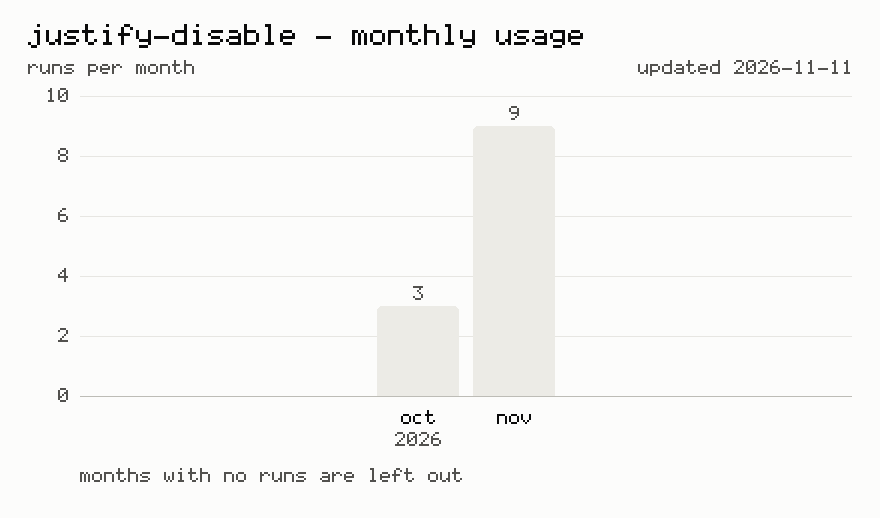
A counted run posts one constant to https://stats.adamczyk.ovh, the same body every time, whether it came from the CLI or the API:
{ "tool": "justify-disable", "options": [] } // `options` is always empty
Where an outbound POST never leaves the network, the same run counts as a plain image GET instead — https://adamczyk.ovh/img/stats/pixel.png?tool=justify-disable — which carries the same single value and nothing more.
Never sent: your code, file names, paths, config contents, violations, the flags you typed, project or package names, and nothing identifying you or your machine. The send is capped at 2s, so a slow or dead endpoint can't hold a run up. Runs that can't ask — CI=true, a pipe, --json, or a project with no config file to record the answer in — are never prompted and never counted.
Changelog
Release history lives in the repo — CHANGELOG.md.